Chapter 1: Introduction
The village of Debenham in Suffolk is a very pretty & relaxing village in Mid Suffolk full of character and charm. The River Deben rises in Debenham, and runs along the ford flowing through to Woodbridge. The ford is thought to be the largest in the United Kingdom. Debenham, with its name originating from the Old English language to mean ‘the village in a deep valley’, was named in the Domesday Book of 1086 as one of the most highly populated villages in the area. East Anglian Kings are reported to have held occasional court here and it is thought that settlers have been in the area since Roman and early English times.
In 1970, the centre of Debenham was declared a conservation area, and due to its charm, Debenham was chosen to represent East Anglia in the Daily Telegraph Festival of Villages 1975.
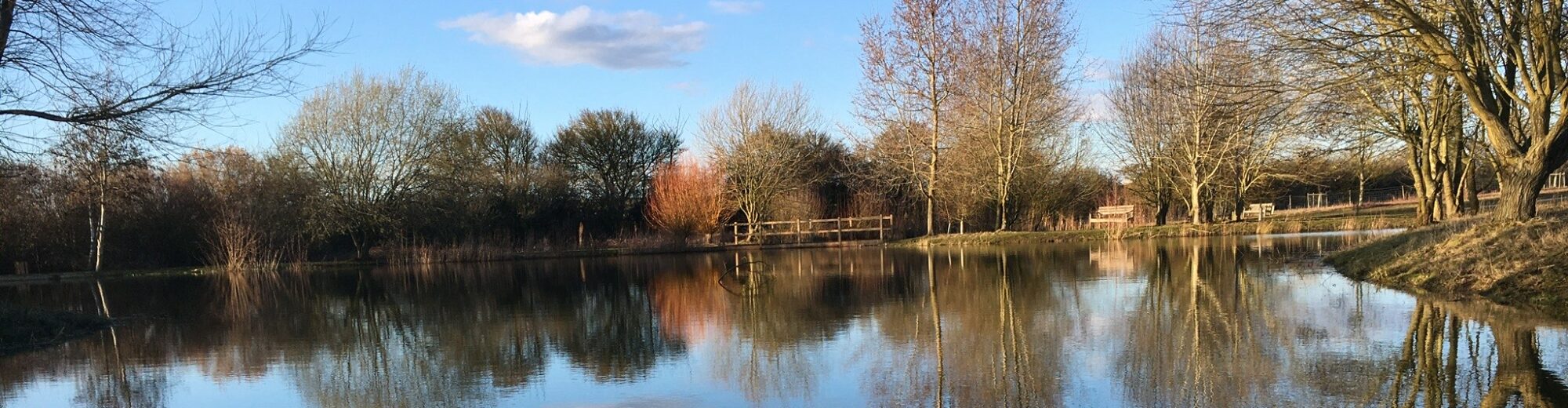
Debenham is surrounded by unspoilt countryside, and the north-east edge of the village enjoys some delightful views over this gentle valley. In the last few years, this area has been enhanced by some changes to its landscape: firstly the Woodland Trust’s Hoggs Kiss Wood, a newly-established 7.5 acre wood, was identified by local resident Charles Keyes as an area which could be planted out as the village’s millennium project. The idea was taken forward by Gerry Baxter with the Woodland Trust for the Debenham community. Then the area was further enhanced in 2004, when work began on an extension to this project for the Debenham community and named The ‘Hoppit Woodland and Lake.’
This booklet is a pictorial celebration of the first ten years of the Hoppit Woodland and Lake. It illustrates the development of the project from initial idea to its fruition and looks forward to its glorious future. It also acknowledges the many people who helped create this wonderful village facility.
Chapter 2: The Dream
The Countryside Agency Market Towns Initiative (MTI) called a public meeting in Debenham on 29 April 2002. The MTI was set up to help small towns (and in our case a large village!) attract tourists, develop facilities and to stimulate the local economy. A number of projects were suggested, one of which was from Gerry Baxter: a working woodland created and owned by the community, for the community. Local people were strongly in favour of the planting of another wood and of taking the opportunity to add to it by creating a lake.
Chapter 3: Early Beginnings
When Hogg’s Kiss Wood was planned, Gerry Baxter raised with the Suffolk County Council (SCC) Woodland and Countryside Officers the possibility of extending or creating another woodland on the adjacent land owned by SCC. The MTI Steering Group agreed that
an expanded woodland, plus the attractive prospect of a lake, could bring about social, as well as economic, benefits to the community.
An agreement was reached with the Countryside Agency and East of England Development Agency (EEDA) to formalise the project. Agreement was reached to lease the land from SCC for 999 years and the task of raising funds began.
A public meeting was held on May 20th 2003 with expert speakers Gary Battell and David Mitchell, followed on June 10th by the first Woodland Steering Group meeting. The project was well and truly up and running! The first Chair was Gerry Baxter who has been a stalwart constant on a fluctuating and hard working committee.
Chapter 4: Aims
The main aims of the Hoppit project are:
- to influence the ecological succession of the site to preserve and increase its wildlife value.
- to create more habitat.
- to provide an amenity for recreation.
- to provide an educational resource.
- to provide woodland products from coppicing, etc.
- to provide an angling facility within the village.
Chapter 5: Creating an Identity
The Green Light Trust was engaged in the initial development of the project. It was thought that their expertise would be particularly useful in encouraging community involvement. They state:
“We’re passionate about ‘Bringing People and Nature Together’ by:
- Enhancing people’s environmental education
- Strengthening local communities
- Helping you achieve results in business through resource management
- Conserving our natural heritage for the future.”
A Constitution, Management Agreement and People Planting Agreement were signed with the Green Light Trust in October 2003, with the full support of the Steering Group and the Parish Council.
The name Hoppit was chosen as it was once the name of a land owner “La Hopper” of an ancient field nearby, a name found on an 1630 tithe map. A ‘hoppit’ was a small meadow by a house, the word being taken from the term ‘hope’ meaning an enclosure.
Chapter 6: The Work Begins
A competition was launched among the local schools with the brief to design a logo for the newly named woodland and lake.
On November 2nd 2003, another public meeting was held at the primary school where villagers of all ages worked in groups to produce designs, having first visited the site. Five different drafts were proposed which were all assessed by the committee at subsequent meetings. By the end of the year the final design was agreed.
Diane Piperno, a professional landscaper from Horham, was engaged to design the lake and adjacent landscape, and she adopted the same outline for the lake as the Hoppit logo, produced by 10-year old Jonty Carruthers, winner of the competition.
Roger Turkington was employed by the Parish Council using MTI funding, and became a key member of the steering group, using his vast experience to apply for numerous grants. Roger also functioned as a project manager during the creation of the lake, and when the MTI funding ceased he continued on a voluntary basis.
In the autumn of 2004, after funding had been obtained and plans were approved, excavation of the 2.5 acre lake began. The work was undertaken by Barry Day and Sons, along with the creation of 450m of footpaths around the lake. A local carpenter, Tony Blackman, constructed the bridges, fishing platforms and benches. The paths and fishing platforms were designed to allow disabled access. The first planting in and around the lake was carried out by Annette Blackman, with some specimen trees to provide a suitable backdrop.
It was crucial to involve community groups and school children in the planting. The wood itself began life with the first seed planting in the tree nursery at Sir Robert Hitcham Primary School on October 14th 2004. ‘Bought-in’ saplings were planted on the site by the primary school children on Friday 27 November 2004. This was followed by community planting at weekends in November and December. Over 1,000 trees were planted in the first phase, with instruction and advice from Elizabeth and Grenville Clarke of the Green Light Trust. (A full list of trees can be viewed in the appendices). Each year over the next five years, more and more trees were added, together with stakes and protective tubes to keep the hungry rabbits and deer at bay. A total of around 5,000 trees have been planted.
To attract people from outside the village, the car-park near the recreation ground was extended and resurfaced and hedged with woodland resources in early 2005.
The official opening was held on June 12th 2005, an unseasonably cold and windy day. Speeches were made, ribbons were cut, a blessing was made and the Hoppit was officially opened!
Once the water had been allowed to settle for a number of months, the lake was stocked with 3,000 fish, including tench, roach and carp.
Chapter 7: The Present
With every passing year the woodland and lake look more and more established. The harsh lines of the hard landscaping have softened as the structures have weathered and plants have taken root. The level of the water varies a lot between summer and winter, but even when the level reached its lowest point during the summer of 2011, the resident fish were tested and were not unduly stressed.
Kingfishers and otters have been seen, and in the summer, mayflies and dragonflies sweep over the lake. Orchids and wild flowers are growing on the surrounding meadow, and in the lake bulrushes and waterlilies are thriving. A family of green woodpeckers have also taken up residence, often to be seen and heard around the lake.
Chapter 8: The Future
The steering committee meets five times a year, ensuring that the Hoppit continues to thrive. Small grants and funding are received from various bodies to help sustain the long-term maintenance of the area, and regular working parties meet to keep the area tidy. Local farmers Martin Durie, Paul Bowler and Ollie Knowland (formerly of Crows Hall), continue to be highly supportive by helping to keep the rides clear and open.
We have our share of environmental challenges: Australian Stonecrop is established in the water, ash dieback has been noted in the neighbouring Hogs Kiss Wood, and during the cold of the winters, rabbits and deer feast on the bark of any unprotected tree. To monitor the woodland and lake, we hold regular working parties to maintain the area and keep it free from litter. These working parties welcome anyone wishing to help with the upkeep.
Trees and hedgerows continue to be added to the woodland, but the planting is largely complete. A recent initiative is the establishment of an orchard in the field north of the lake, where varieties of Suffolk apple and pear trees are being introduced.
The wood, lake and orchard will develop over time and an established, self-sustaining environment will result, and future generations will be able to enjoy and cherish this wonderful area. This book is offered as a testament to those who made the dream become reality.